
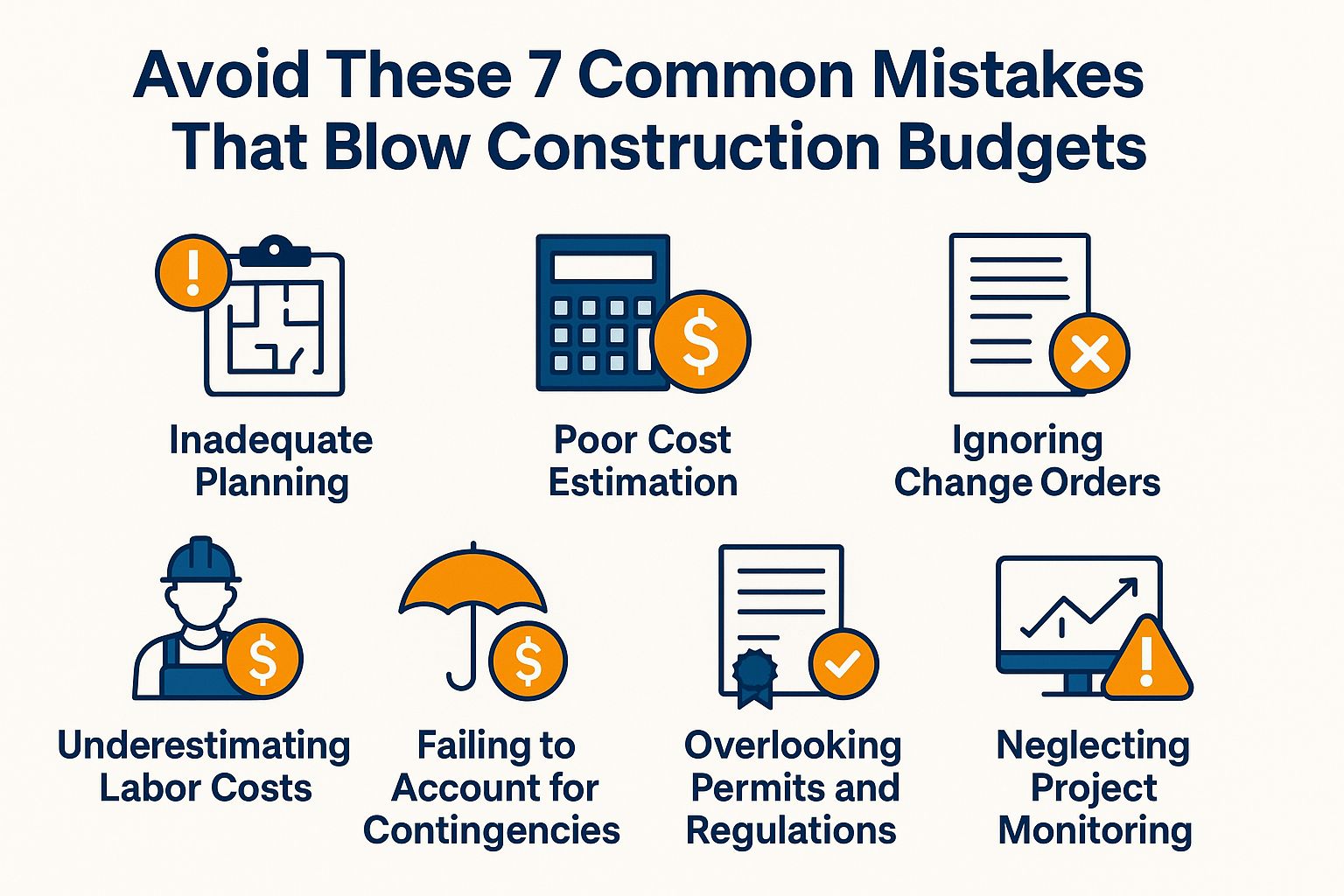
Avoid These 7 Common Mistakes That Blow Construction Budgets
Every building plan begins with big ideas, but surprise expenses can quickly ruin those plans. You need to keep your budget on track to avoid financial pitfalls. From inadequate planning to overlooking permits, these seven common mistakes can drain your resources. Want to safeguard your next project? Let’s look at these expensive mistakes and give you the information you need to keep your budget on track.
Importance of Budget Management in Construction
Managing construction budgets is key, impacting whether projects move forward and stakeholders’ satisfaction, while minimizing budget overruns.
Effective budget management directly impacts project outcomes by enhancing Return on Investment (ROI), improving completion rates, and addressing project delays.
For example, using budgeting software like Procore or Buildertrend allows teams to track expenses in real-time, leading to quicker adjustments when forecasts deviate.
According to studies, projects with strict budget oversight see completion rates rise by 30%. Regular financial checks help keep projects on schedule and within budget.
By encouraging openness and responsibility, teams can increase trust from stakeholders and improve project outcomes.
Overview of Common Budget Mistakes
Knowing usual budget mistakes can help construction teams save a lot of money. Typical errors include not planning well enough and estimating costs poorly.
Inadequate planning often leads to unexpected costs. For example, failing to account for material price fluctuations can inflate budgets by up to 20%. Similarly, poor cost estimation arises from relying too heavily on outdated data or estimates without proper validation.
Using tools like ProEst or Buildertrend can make estimating easier and improve accuracy. Setting aside contingency funds-typically 10-15% of the total budget-can cushion against unforeseen expenses, offering a financial buffer that protects project integrity and promotes successful delivery.
Mistake 1: Inadequate Planning
Poor planning often leads to budget problems, causing projects to expand beyond their original plans and face delays.

Understanding Project Scope
Clearly defining project scope and project scope definition is essential; 60% of project failures stem from unclear requirements.
To effectively define project scope, start with stakeholder interviews. Talk to important people to learn what they expect and need.
Follow this by drafting a detailed scope statement, which outlines project objectives, deliverables, and constraints, ensuring effective project documentation.
Programs like Microsoft Project are very useful; they help you see schedules and how resources are distributed, ensuring proper resource management and coordination.
Regularly reviewing this scope can help adjust as necessary, avoiding scope creep and keeping the project on track.
Setting Realistic Timelines and Milestones
Setting realistic deadlines is important because 70% of construction projects take more time than expected due to unrealistic scheduling and poor management of timelines.
To successfully handle your project schedule, begin by dividing your project into stages and tasks. Use a Gantt chart to display these steps and their connections. You can create one using tools like Smartsheet or Microsoft Project.
Schedule regular check-ins to assess progress, adjusting timelines as needed based on actual work completed. Consider using task management software like Asana or Trello for tracking daily and weekly goals.
This method simplifies your work process, ensures your project stays on schedule, and avoids extra costs.
Mistake 2: Poor Cost Estimation
Wrong cost estimates can raise project costs by as much as 15%, leading to serious budget issues and financial dangers.

Common Estimation Techniques
Effective cost estimation techniques like Analogous Estimating can reduce budget discrepancies by up to 10%, improving cost control.
To improve accuracy, use methods such as Parametric Estimating, which relies on statistical connections between project elements to estimate costs based on past data.
Programs like Estimator and PlanSwift simplify this task, helping users create clear reports and view information clearly.
For example, if a similar project had a cost per square foot of $150, you could apply this figure to a new project of 2,000 square feet, estimating a total of $300,000.
Using these methods helps make better decisions and manage the budget more closely.
Factors Influencing Cost Estimates
Cost estimates in construction are influenced by material costs, labor rates, and market conditions, which can fluctuate significantly due to economic factors.
To effectively monitor these variables, start by regularly checking local suppliers for material prices, as they can vary week-to-week.
Use construction labor market reports to keep up with wage patterns in your region. Subscribe to industry newsletters or join professional associations to receive updates on market conditions that could affect project costs.
For example, if concrete prices surge due to supply chain issues, you might consider alternative materials or adjust your project timeline to lock in better rates. This new approach can lead to more accurate financial planning.
Mistake 3: Ignoring Change Orders
Overlooking change orders can cause project expenses to go over the initial budget by 30%, putting a heavy financial burden and causing oversight issues.
What are Change Orders?
Change orders represent modifications to the initial project scope, which can affect timelines and costs.
To effectively manage change orders, first document all requests using a standardized form, which helps track details like the nature of the change, reason, and impact on the budget and schedule.
- Second, quickly review these changes-preferably within 24-48 hours-to update stakeholders about possible changes. For example, using project management tools like Trello or Asana can make communication easier.
- Always obtain written approval before implementing changes, ensuring all parties understand the implications consistently.
How to Manage Change Orders Effectively
Effective management of change orders involves a formal approval process, which can reduce budget impacts by 15%.
To make this process easier, use tools like Procore, which offers a complete system for monitoring and recording change orders.
Start by integrating your project plans with Procore, allowing you to easily create change order requests that include detailed descriptions and cost estimates. Allow all team members to review and give feedback to encourage working together.
You might consider setting up notifications to update stakeholders about approvals or changes. This forward-thinking method increases openness and helps keep project timelines and costs on track.
Mistake 4: Underestimating Labor Costs
If you don’t calculate labor costs correctly, project expenses can go up by as much as 20%, which can greatly reduce profits.

Factors Affecting Labor Costs
Factors such as skill level, overtime rates, and regional wage differences can drastically affect labor costs.
To properly factor labor into your budget, begin by researching to find the typical hourly wages for your area and field. Use tools like Glassdoor or Payscale to gauge typical wages.
Next, categorize your tasks: consider separating routine tasks from specialized work, as this can highlight different skill levels. For instance, a graphic designer might charge $40/hour, while a web developer could ask for $70/hour.
Factor in potential overtime and benefits-estimate approximately 20% above base salary for overhead costs. Monitoring these elements will help you better understand your labor expenses.
Strategies for Accurate Labor Costing
Implementing regular labor audits can lead to a 10-15% reduction in labor cost overruns.
To achieve this, begin by utilizing workforce management tools like TSheets or Deputy. These platforms let you monitor employee hours, project time, and overtime easily.
Begin by doing monthly checks to find any differences between planned and actual work hours. For example, if a specific department consistently exceeds its hours, consider adjusting staffing or workload.
Use these tools’ reports to forecast staffing needs correctly and make informed hiring decisions, preventing any unnecessary hiring.
Mistake 5: Failing to Account for Contingencies
Not saving money for unexpected expenses and financial risks can cause serious budget problems, with many projects suggesting setting aside 5-10% of the total budget for contingency funds.
What is a Contingency Fund?
A contingency fund serves as a financial buffer to address unforeseen challenges during a project.
Setting up a backup fund can be important for project success. A general guideline is to allocate 5-10% of the total project budget for these funds.
For instance, if your project budget is $100,000, creating a $5,000 to $10,000 contingency fund helps cover unexpected expenses like equipment failures or project delays.
To handle this fund well, keep it easy to access but not mixed with day-to-day funds. Regularly review expenditures to avoid dipping into it unnecessarily, thus keeping your project on track and within budget.
How Much Contingency to Include for Effective Budget Tracking
Construction projects should ideally allocate between 5-15% of their total budget for contingency funds, depending on project complexity.
To determine the right amount, assess your project’s risk factors. For example, a high-rise building in an earthquake zone may require a 15% buffer, while a simple renovation might only need 5%.
Analyzing similar past projects can guide this decision; if a previous project went over budget by 10% due to unforeseen delays, you may want to match or exceed that percentage during the planning phase.
Think about using tools like PlanRadar for real-time information and data analysis to improve your backup plans and resource allocation.
Mistake 6: Overlooking Permits and Regulations
If you don’t get the needed permits, your project might be delayed and you could face fines, which can add 10-15% to your total budget and affect your budget planning.
Identifying Necessary Permits
Getting the necessary permits early can help prevent costly delays and meet legal requirements.
Project managers need to consider obtaining several key permits, such as:
- a building permit for structural work;
- electrical and plumbing permits for installations or upgrades;
- zoning permits to confirm the project follows local land use rules;
- and environmental permits if the project impacts wildlife or water bodies.
To make the process easier, use online tools like PermitHub or PlanHero to follow requirements and send in submissions. Engaging with local authorities early can also clarify requirements, enabling smoother project execution and reducing the risk of non-compliance penalties. This is important for managing the site well and preventing unexpected events that can impact your project deadlines.
Costs Associated with Non-Compliance
Non-compliance can incur fines and additional costs, sometimes exceeding 20% of project budgets, which can significantly impact financial planning.
To lower risks, use tools like Permit Wiz, which helps with tracking and managing compliance rules specific to your field. This software finds the required permits and alerts you when it’s time to renew them, helping to prevent mistakes.
Implementing regular audits can flag potential compliance issues early, saving considerable costs in the long run. For example, a construction firm using Permit Wiz reported a 30% decrease in compliance-related fines after one year of consistent usage, showcasing the financial benefits of proactive compliance management.
Mistake 7: Neglecting Project Monitoring
If you don’t keep track of a project’s progress, it can result in spending too much.
Research indicates that checking in regularly can reduce expenses by up to 15%.
Importance of Regular Budget Reviews
Checking your budget often helps spot problems before they get big, so you can make better decisions and reduce money problems through effective budget revisions.
Review your entire budget every month. Begin by gathering your financial statements and using tools like QuickBooks or Mint to track income and expenses. This practice aids in better financial forecasting and project monitoring.
Then, compare your actual spending against your budgeted amounts. If discrepancies appear, analyze categories such as groceries or utilities where adjustments may be necessary.
Think about using zero-based budgeting. In this method, you allocate each dollar a purpose, helping you maintain better control over your spending habits. This proactive method can significantly improve your cash flow management and long-term financial health, ensuring effective budget approval processes.
Tools for Effective Project Monitoring
Tools like Trello and Monday.com make it easier to track projects, allowing teams to manage budgets and schedules effectively.
To keep track of your budget more easily, consider using tools like Asana, ClickUp, and Smartsheet.
Asana helps track expenses with its custom fields feature, while ClickUp offers a dedicated budgeting tool to manage project costs. Smartsheet combines project management and budget tracking in a format similar to a spreadsheet.
Each of these tools integrates seamlessly with financial software like QuickBooks or Xero, enabling real-time updates on project expenses. Using these platforms helps teams stick to their budget and finish projects on time, thereby enhancing contractor performance and project delivery.
About the Author
Daniel Grant is a University of Florida graduate with a bachelor’s degree in Business Finance. He is a writer and editor for Used Construction Trailers and the owner of a successful mobile office and trailer supply company in Jacksonville, Florida. With over 11 years of experience, Daniel helps businesses secure affordable office solutions that are flexible, reliable, and built to last.
Leave a Reply